




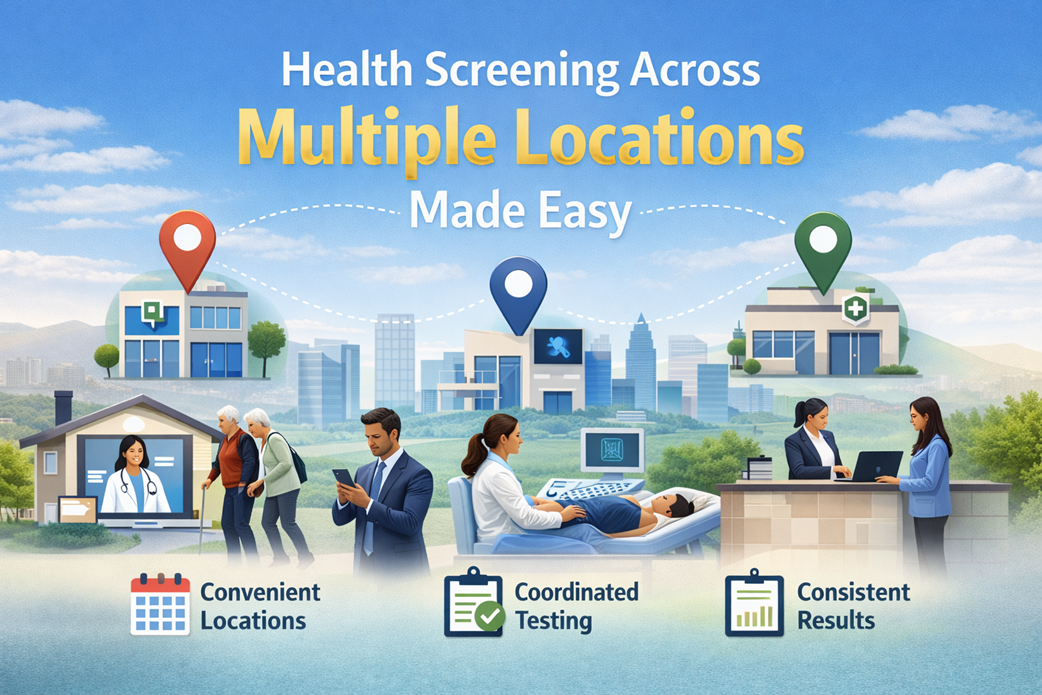
Health Screening Across Multiple Locations Made Easy
If you’ve ever tried to schedule a routine blood panel, an ultrasound, and a follow-up test—only to realize the “best” option for each is in a different neighborhood—you already understand the friction. You’re not choosing care based on what you need; you’re choosing based on what you can fit between work, school pickup, and traffic.
That’s why getting your health screening at a convenient location is a nice-to-have feature. It’s a practical way to keep preventive care on track, especially when families, working professionals, and employers need speed, consistency, and dependable reporting.
Why health screening multiple locations matters
Preventive screening works when it’s done on time and repeated consistently. The moment access becomes complicated, people postpone labs, skip imaging, or do tests only when symptoms show up. The convenience of choosing from multiple locations reduces the scheduling gap between “I should check this” and “I got it done.”
For individuals, it often means you can get a fasting blood draw near your home, office, or community in Dubai, Abu Dhabi, Sharjah or Ajman, or book an imaging near your office, and still have the results organized in a way your physician can use. For caregivers, it means coordinating appointments for a spouse, parents, or kids without driving across town. For employers, it means enrolling staff in pre-employment exams or wellness screenings with fewer no-shows and less administrative back-and-forth.
What “multiple locations” should actually include?
Not every “multi-location” claim is equal. Some providers have a handful of sites but limited hours or narrow test menus.
When you’re evaluating access, think in terms of three realities:
First is proximity: do you truly have options near home and near work, not just “somewhere in the city”? Second is capacity: are appointments available this week, and do they offer early-morning slots for fasting blood tests? Third is clinical coverage: can you book both lab work and imaging without starting over with a new provider?
If you need more than routine lab tests—say an MRI, CT scan, ultrasound, or X-ray—location flexibility matters even more. Imaging schedules fill quickly, and people often delay it because of timing. A wider network can keep your diagnostic pathway moving.
Check our website or connect with us to know about our multiple locations.
Choosing the right screenings when you have location flexibility
Access is only useful if you’re clear on what you’re booking. The most common mistake is choosing tests based on what’s convenient rather than what’s clinically appropriate.
Checkup Packages are a practical starting point for many adults because they reduce decision fatigue. A well-structured package typically includes core metabolic markers (blood sugar and lipids), kidney and liver markers, and a complete blood count. Gender-specific packages often add prostate markers for men or fertility/hormone-focused testing for women, depending on age and risk factors.
If you’re managing a known risk—prediabetes, high cholesterol, thyroid symptoms, fatigue, low vitamin levels, or a family history of cardiovascular disease—individual profiles can be more precise than a general package. For example, diabetes monitoring may require HbA1c trends, fasting glucose, and related metabolic markers, while heart health decisions may depend on lipid fractions and inflammatory indicators.
Discreet screening is another area where convenience changes behavior. When STD testing, immunity checks, or fertility screening can be done quickly at a nearby clinic—or with at-home sample collection where appropriate—people are more likely to act early, which improves outcomes and reduces downstream costs.
Always consult your doctor to understand the right tests for you.
How to keep results consistent across sites
The trade-off with health screening multiple locations is variation. Different clinics can use different analyzers, reference ranges, and reporting formats. This doesn’t mean the results are unreliable, but it does mean you need to be intentional if you’re tracking trends.
If you’re monitoring a chronic risk (like A1c, LDL cholesterol, thyroid markers, or iron stores), try to repeat tests within the same coordinated network when possible. Consistency improves comparability. When switching sites is unavoidable, ask for clear reporting that includes units, reference ranges, and specimen details. Your physician cares about pattern and context, not just whether a value is flagged high or low.
Timing also matters. Lipids can shift after recent illness, travel, sleep disruption, or changes in diet. Hormones may vary by time of day and cycle phase. Vitamin D can drift seasonally. A multi-location model helps you get tested sooner, but the best clinical decision-making comes from repeatable conditions—same test, same laboratory, similar preparation, similar timing.
It is best practice to always discuss your results with a doctor and seek proper medical advise.
What to ask before you book at a new location
When access is broad, the goal is not just “find a clinic.” It’s “find the right clinic for this specific test.”
Start with licensing and oversight. Diagnostics is not a commodity; quality depends on compliance, calibration, and process. Confirm the clinic and labs are properly licensed and that results are issued through recognized, accountable channels.
Next is the operational question: what’s the turnaround time for reporting? Fast reporting isn’t only about convenience. It changes whether you can act on results this week or lose momentum and postpone follow-up.
Finally, confirm pre-test requirements. Some tests require fasting, others don’t. Certain imaging may require preparation, prior reports, or clinical notes. If you book across multiple locations, you want standardized instructions so you don’t arrive unprepared and have to reschedule.
At-home collection vs. in-clinic: when each makes sense
At-home sample collection can be the difference between “I’ll do it later” and “I did it.” It’s especially helpful for busy professionals, caregivers, and anyone who finds clinics stressful.
That said, it depends on what you’re testing. Many blood tests can be collected at home by trained phlebotomy staff, assuming proper handling and transport. It’s a strong option for routine monitoring, wellness panels, and certain profiles.
Imaging is different. MRI, CT, ultrasound, and X-ray require equipment and trained technologists. In that case, a convenient location matters because you’ll still be traveling—but you can choose the nearest site with the earliest availability.
Even within blood tests, there are scenarios where in-clinic is preferable. If you have a history of difficult blood draws, need multiple tubes collected, or want immediate support if you feel lightheaded, a clinic setting may be more comfortable.
You may get in touch with us to book a home sample collection or to book an in-clinic appointment.
Health screening multiple locations for employers and HR teams
When HR teams coordinate pre-employment exams or corporate wellness days, the operational burden is the hidden cost. Employees may be distributed across a metro area, have different shift schedules, or join at different times.
A multi-location approach helps standardize what each employee receives while reducing the likelihood that someone misses their appointment due to travel constraints.
The key is standardization. Employers want the same exam components, and similar predictable turnaround times—whether an employee tests near headquarters or near home. When screening is coordinated through a single booking and reporting pathway, HR teams spend less time chasing results and more time acting on them.
Connect with us to know more about our on-site and in-clinic corporate health screening services.
A practical way to book across locations without losing control
The easiest experience is when one platform coordinates selection, scheduling, and reporting across a vetted network. That structure allows you to choose a package or individual test, pick the nearest available clinic, and receive results in a consistent format.
This is exactly the model used by Healthchecks360: a preventive healthcare and diagnostics marketplace that coordinates lab tests, packaged checkups, specialized profiles (from diabetes and hormones to STD/ STI screening and vitamins/minerals), and radiology services (MRI, CT, ultrasound, X-ray) across multiple licensed partner locations, with at-home collection available for many lab needs.
Whether you use a marketplace model or a single provider, the same principle applies: keep your diagnostic history organized. Save PDFs, track dates, and bring prior results to physician visits. The value of screening is not just the snapshot—it’s what it reveals over time.
The trade-offs to be aware of
More locations can introduce more choice than you want. If you’re unsure what to book, you may bounce between packages and individual tests without a clear clinical goal. When that happens, start with your physician’s priorities or a focused package aligned to your age and risk.
Also, faster isn’t always better if it compromises preparation. A same-day slot is great, but not if you didn’t fast when required or scheduled hormone testing at an inconsistent time. The best systems make instructions obvious and help you get it right on the first visit.
And while broad access can reduce delays, follow-up still matters. Abnormal results don’t diagnose a condition on their own; they indicate next steps—repeat testing, additional markers, or imaging confirmation. The most useful screening experience is one that makes those next steps easy to schedule.
Preventive care is a habit, not a one-time event. When you can choose the location that fits your week—and still get reliable, physician-ready results—you’re far more likely to keep that habit for the long term.
*This content is for general information only and does not replace medical advice.